
Nullam dignissim, ante scelerisque est euismod fermentum odio Sem semper l'est erat, un feugiat leo urna eget eros. Duis Énéenun imperdiet risos.
Chargement
Nullam dignissim, ante scelerisque est euismod fermentum odio Sem semper l'est erat, un feugiat leo urna eget eros. Duis Énéenun imperdiet risos.
The fenestration system is no longer merely an architectural aperture but a critical thermodynamic boundary governing the energy flux between the controlled indoor environment and the variable exterior climate. As energy codes (such as Energy Star et California Title 24) tighten, the reliance on generic default values for aluminum profiles has become obsolete.
The NFRC certification protocol offers the only standardized methodology to bridge the gap between theoretical thermal breaks and actual installed performance. For aluminum profiles utilizing PA66 nylon thermal barriers, this certification is the definitive validation of thermal continuity.
The credibility of NFRC ratings lies in its hybrid methodology, which bifurcates into two synchronized tracks to ensure data accuracy:
Utilizing the Lawrence Berkeley National Laboratory (LBNL) software suite, specifically THERM (for two-dimensional heat transfer analysis of frame cross-sections) and WINDOW (for total product performance), certified simulators model the complex geometry of the profile.
Simulation data is not accepted in isolation. It must be corroborated by physical testing in a thermal chamber (Hot Box).
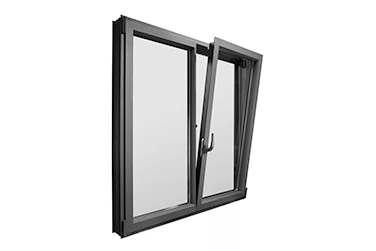
In the context of a 70-series broken bridge aluminum casement window, the NFRC methodology reveals the efficacy of specific engineering decisions:
Beyond the primary metrics, the geometric configuration of the profile dictates the Isotherm Alignment. In the 70-series assembly, the PA66 thermal strut is engineered to be coplanar with the IGU’s insulating spacer, effectively minimizing the linear thermal transmittance (Ψ-value) at the glazing interface. THERM analysis verifies that the critical 10°C isotherm remains contained within the insulation zone, preventing localized dew point crossover. Furthermore, the mechanical interface (knurling) between the aluminum and polyamide strip ensures the assembly maintains its thermal integrity even under differential thermal expansion, preventing seal failure that would compromise long-term NFRC compliance.
Optimizing the Total Product U-factor (Utotal) requires a granular analysis of the Edge-of-Glass (Uedge) zone, which often serves as a weak point in thermal envelopes. In the NFRC simulation environment, we rigorously model the linear thermal transmittance (Ψg) at the interface between the glazing unit and the sash profile. To mitigate thermal bridging, the 70-series system is compatible with Warm Edge Spacers (stainless steel or composite polymers), which replace highly conductive aluminum spacers. The THERM finite element analysis (FEA) explicitly calculates the conductive coupling between the primary seal (PIB), secondary seal (Silicone), and the PA66 thermal strut, ensuring thermal continuity across the sightline.
Furthermore, the simulation accounts for complex cavity gas dynamics. By evaluating the aspect ratio of the inter-pane cavity, the model predicts the suppression of convective loops when utilizing inert gas fills like Argon or Krypton (at 90% concentration). This is synchronized with Spectrally Selective Low-E coatings, where we optimize the Light-to-Solar Gain (LSG) ratio to filter Near-Infrared (NIR) radiation. This holistic modeling ensures that the superior Center-of-Glass (Ucog) metrics are preserved and not degraded by frame interaction, strictly adhering to the NFRC 100 boundary conditions (Tout = -18°C, Tin = 21°C) to validate performance under extreme thermal stress.
The NFRC certification process extends beyond initial testing. To ensure the “As-Built” product matches the “As-Simulated” design:
The rigorous NFRC methodology described above is not merely theoretical; it serves as the manufacturing backbone for leading fenestration providers. The “70-series” system analyzed in Section 3 represents the core engineering philosophy at de Yuxinyuntong (Tianjin) Technology Co., Ltd.
Translating these complex simulations into tangible products, we operate from the Tianjin Science and Technology Innovation Park under our independent brand “HuaXiaXinBao.” We combine advanced manufacturing with the rigorous quality control protocols required by NFRC audits, ensuring that every aluminum window and curtain wall system strictly meets global thermal and acoustic standards. Our commitment to this “closed-loop” verification allows us to deliver customized, durable building envelope solutions to an international clientele, successfully bridging the gap between architectural vision and engineering reality.
This move from basic material specifications to NFRC certification for performance represents a maturation of the fenestration industry as a whole. The NFRC label on a 70 series broken bridge aluminum window represents not only a level of compliance for architects and building envelope consultants but also a level of verified information that is obtained through a very scientific, closed-loop process.
By using this dual-track approach to verify not only the hardware, but also the PA66 thermal breaks and sealing systems, this approach guarantees that the level of energy savings that is anticipated through this process is ultimately achieved in the real world.
Data is the currency of modern construction. Stop relying on estimates and start building with verified precision. Whether you are targeting LEED certification, Passive House standards, or simply demanding the highest thermal comfort, Yuxinyuntong’s 70-Series offers the certified metrics you need.
Don’t leave your building envelope’s efficiency to chance.
[Consult with our Engineering Team]: Request a site-specific thermal analysis and see how the 70-Series optimizes your building’s energy model.
Q: How does NFRC certification differ from standard manufacturer thermal ratings?
A: Unlike ratings based solely on theoretical calculations or generic data, NFRC employs a “Dual-Track” approach. It validates computational data (generated by LBNL’s THERM/WINDOW software) with physical testing in a guarded hot box. The simulation results must align with physical test data within a strict tolerance (e.g., ±10%), creating a “closed-loop” validation that ensures the rating reflects the window’s actual performance.
Q: What is the specific function of the PA66 nylon strip in the 70-series window?
A: PA66 nylon strip is used as the “thermal break” material inside the aluminum profile. It is used to keep the aluminum frame on the outside of the window while the inside remains isolated by the PA66 nylon. As a result, the amount of conductive heat reduction is minimized, thereby decreasing the “U” factor and increasing the Condensation Resistance as per the NFRC 500 standard.
Q: How can I be sure the windows delivered to my site match the certified performance values?
A: The NFRC certification process includes a rigorous “Product Autopsy” protocol to ensure consistency. Inspectors may disassemble random units to verify that internal components—such as the wall thickness of the aluminum profile and the geometry of the thermal break—strictly match the CAD drawings and material specifications submitted for the initial simulation.










Laisser un commentaire